
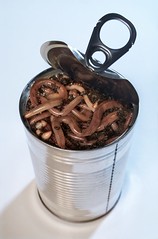
- Image by Marco Veringa via Flickr
The whole issue of parochialism and the cringe just won’t.go.away!
This last week there’s been chatter on the social networks from local playwrights who are angered that a theatre reviewer considers their work to be pretty much second-rate. There’s no doubt, if you read between the lines of some of the commentary, that writers are frustrated by the lack of opportunities – material and financial resources in particular – for new and subsequent productions of their work here in Queensland. As many note, it is through getting your work on stage in production that you learn the craft of playwrighting.
The problems surrounding getting a new work to production, and then to a second production cannot be overstated, and it’s apparently the same in the US. The recently-published Outrageous Fortune contends that US dramatists cannot get new works produced, and that established writers are squeezing out the newcomers. They’re as mad as hell about it, and a series of ‘town-hall meetings’ in the American tradition were held in major US cities recently to discuss the economics and the politics of the issue.
Closer to home, the interview that sparked the reaction aired last week on 612 ABC Brisbane during a show called Drivetime. It was one of those cosy radio roundups of the local theatre week: mild in tone, lots of laughs, anecdotes, civil airwave chat. Local writer and theatre reviewer Sue Gough and regular theatre commenter Doug Kennedy were interviewed by Kelly Higgins-Devine. The conversation on the week’s Matilda Awards developed around what Kennedy called the ‘positive discrimination’ at work in funding for local writers. Sue Gough had noted the success of the unfunded 23rd Productions with The Pillowman by Irish writer Martin McDonagh. Higgins-Devine then asked Gough point blank, ‘Are Australian playwrights up to scratch compared with some of their international peers?’ Gough (bravely and/or foolishly – depending on your point of view) responded as bluntly, ‘In a word, no,’ and went on to respond that, in Australia, you could count the ‘brilliant ones’ on the fingers of one hand. Well, yes, I guess so. After all, ‘brilliant’ is a big call in any country – and ‘some’ is a key word when you’re doing any kind of comparison – which we know are odious at the best of times! If you’re interested, here’s the link to the interview.
After suggesting that local writers need the benchmarking of the best of overseas writers to ‘learn’ from, Sue Gough then went on to say that one reason the local Matilda Awards were created was to focus on Queensland work because no one from ‘the perceived centres that matter’ gets to see our work – whose perception? As a result, Queensland productions were therefore not eligible for those other cities’ Green Room or Helpmann awards. It was at this point when the issue of bringing ‘them’ (the critics) up from ‘down there’ to see ‘our’ work and get it ‘on the radar’, that I realised a potentially excellent discussion had been derailed – again – by the cringe beast.
So, a correction to start. The comment that ‘our plays’ are not being seen outside Queensland is nonsense. The Playing Australia funding scheme Sue Gough mentioned in passing (the Long Paddock process), as well as independently developed co-productions between Australian theatre companies, mean that Queensland plays, artists, creatives and their work are seen in other state regional and metropolitan centres and capital cities. As I write, Queensland resident Michael Gow‘s Toy Symphony is on the road nationally, and, if it hasn’t already, is about to play its 100th performance. The Matilda award-winning production (2007) of Matrix Theatre’s The Kursk by Sasha Janowicz toured nationally last year, and Queensland Theatre Company’s co-production with MTC of Let the Sunshine by David Williamson – another Queensland resident – will soon tour to Melbourne. Then there’s Brisbane‘s The Escapists with Boy Girl Wall which played the Adelaide Fringe Festival recently, and is due to open in its home city in August this year. This is a sampling of Australia’s national theatre – it’s common-wealth of theatres. Is the point made?
We need more, not less public conversation about the state of the arts here and elsewhere in Australia. There’s nothing wrong with strong points of view – in fact, we should be encouraging them – but uninformed opinion must always be challenged. Not to do so is … unhelpful, to say the least. So ABC, how about a series of conversations on theatre issues that matter? I’m thinking of the kind of intelligent and entertaining jousts over film and the local industry that David Stratton and Margaret Pomeranz have from time to time. You could do worse than by interrogating Sue Gough’s contention that local theatre needs the best of non-Australian plays to serve as a ‘benchmark’ and from which local writers can learn. Then invite a Queensland playwright to the table. Now that I would tune in for!
Related articles by Zemanta
- 2010 Matilda Awards: all the winners (actorsgreenroom.net)
- Conversation with the audience: Sven Swenson, playwright (actorsgreenroom.net)


