David Walters (Interview 27)

I’m conscious that this interview has been quite a while in the write-up. Of course, I have no one to blame but myself and the busy-ness of life since I sat down to talk with David Walters beside a cosy fire after a delicious dinner on the last day of July. However, I’m also going to blame him (at least in part) for the vast amount of fascinating material I’ve had to sift through; I recorded our chat and took copious notes that night.

David Walters is a softly-spoken, articulate, and passionate raconteur. He is also particularly modest about his own achievements and I had to probe to find out more about his work. That night he was genuinely enthusiastic in sharing his vast knowledge on the subject of light itself, something that clearly engages him. What I had thought would be a simple chat about his work as a lighting designer and the challenges of Water Wars – the show we were both then working on – became a wonderfully rich tutorial for me on the philosophy of light, technology, art, and sustainability.

I feel privileged to be where I am right now. I have at my disposal ways of creating light no one else has ever had.

As we get started, David sets the scene like an expert tale-teller. He riffs on the philosophy of light as a metaphor for goodness and knowledge, and moves on to the social history of light creation.

In order to light cities some species of whales were hunted to extinction for their oil, and I learn that the probably well-lit streets of Denmark in the 16-17 centuries were fragrant with the smell of cod-liver oil! Candles were once a marker of wealth – ‘Staying up all night was very fashionable in the 18th century,’ he tells me, ‘if you could afford it.’ Such conspicuous consumption means that one night’s revelling could burn up the equivalent of a worker’s annual salary. However, this form of lighting was also a sustainable product. ‘People ate their tallow candles when times got hard.’ We head then towards the introduction of gas lighting, and I find out why ‘limelight‘ got its name. We move right along in lighting history to the coming of the incandescent bulb and the invention of whole new kinds of light throughout the 20th century. This culminated in the development of the LED (light-emitting diode) which, David tells me, has been around for a while, at least since the 1990s. ‘We’ve learned how to mix white via the RGB spectrum but,’ he notes, ‘LEDs were not very powerful or useful.’ Apparently it just took a bit longer to learn how to ‘cajole more light from them using chemical elements.’ At the mention of physics, my eyes may well have glazed over, so David moved on swiftly to art history. Continue reading “David Walters (Interview 27)”
Wesley Enoch (Interview 28 )

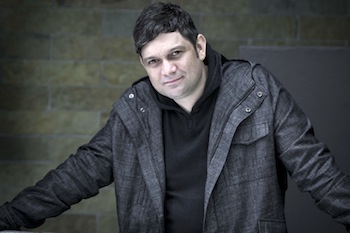
I’m interviewing Wesley Enoch in his inner-city apartment in Brisbane – 5 minutes on foot to Queensland Theatre Company headquarters on South Bank where he is Artistic Director, and 7 minutes to the Airtrain connection at South Brisbane station – important when you do as much travel as he does. He loves walking to relax although he confesses he doesn’t do as much as he should. ‘I’ll get back to it now the warmer weather is coming in.’ Whilst Wesley doesn’t own a car, he does have some wonderful pieces of art. We’re surrounded by prints, paintings, photographs, ceramics – all Australian and many by indigenous artists – on walls and shelves. Each of them has a story and, when I first arrived, he took me through them one by one.

He’s been on the job now just over a year – he took up his appointment on 19th of July 2010, although it’s been in a full-time capacity since the beginning of this year only. I’m keen to learn more about how it’s going, to hear Wesley’s thoughts on the business of being an Artistic Director today, and what it’s like being back home after all these years.

He’s a Stradbroke Island man, educated and raised in Brisbane and a graduate of QUT with a BA in Drama Majoring in Dance. Wesley then went on to do an Honours year at QUT – and his dissertation topic? Establishing a context for the understanding of contemporary aboriginal arts.

Wesley was the first indigenous Australian appointed as Artistic Director of a major theatre company. I ask how important it was to him. He responds, ‘It really hadn’t occurred to me until Neil (Armfield) rang and congratulated me. I was more focussed on a personal ambition to engage with a wider audience.’ He shrugs, relaxed about it, ‘people had been waiting for it to happen, and it did. One of the outcomes has been that more of the discussion about establishing a national indigenous theatre company now seems to be flowing towards QTC.’ He adds, ‘I was talking to students recently and saying that when you are in your 20s you’re radical and revolutionary but in your 40s you’re more evolutionary. The radicalism of my 20s is now the evolutionism of my 40s. I’m thinking now of how we work on the aesthetics and not just the politics. The 20 year old has achieved the goals.’ Continue reading “Wesley Enoch (Interview 28 )”

Jamie Simmons: Food, Drink, Think (Interview 26)

I follow a lot of people and organisations on Twitter and, a month or so ago, I noticed that an account for a cafe, @jamjarbrisbane was tweeting some verrry interesting lunchtime menus – worth following and checking out for myself, I thought, and so I did.

I met Jamie Simmons the Jam Jar’s co-proprietor that day – another face to face tweetup between total strangers – and, somewhat to my surprise, he shared his thoughts about opening up the café for live performance.  The Jam Jar’s philosophy or modus operandi is ‘Food, Drink, Think,’ and Jamie wanted to pair the hospitality of food and drink with his love of performance – especially theatre – to create a venue where spoken word, slam poetry, short plays and performance in general could happen every couple of weeks. It turns out he went on to do just that, and so it seemed a good idea to catch up with Jamie and see how it was all going.

We sat down to have lunch and chat, and this is what we said … it’s a 5 minute audio interview with all the background details … enjoy! (Our lunch arrived just after I’d done the intro – hence the slight repeat. I can thoroughly recommend their burger, by the way.)

Performing in the Jam Jar (mp3)


Their next Theatre night is August 16th, and the first Open Mic Slam Poetry session is on this coming Sunday afternoon August 14 at 3pm. All the details can be found on The Jam Jar’s website – http://www.jamjarwestend.com. That’s also where you can find out more about submitting work and taking part in their ambitious program of activities. PS Jamie is smart enough to have appointed an Artistic Director (Mariana Jocelyn aka ‘Rocket’) to handle that side of the business, so the prognosis is good!

I’ll be back. As well as the burgers, Jam Jar’s coffee is also very good.

Liesel Zink (Interview 25)

Liesel Zink is in rehearsal right now for a new work coming to Metro Arts Allies; she has created, choreographed, and is performing in A Collection of Various Selves, an appropriate title, perhaps, for this multi-faceted artist.

I ask Liesel whether she thinks of herself predominantly as one or other of these roles?  It’s flexible. ‘I have done a few movement rather than dance projects,’ there is a difference, ‘and I am now working more with actors as choreographer and beside them as performer.’ She continues, ‘I really enjoy shaping natural movement with actors, and I’m starting to combine the two in my own practice more and more.’ What also emerges as we chat for about an hour is her interest in psychology, research, body language, and the minutiae of daily human exchange as feeders for her own creativity.

A QUT graduate in Fine Arts (Dance), Liesel’s Honours research delved into body language. As she developed as a dancer she started to become interested in how we communicate in everyday ways through gesture and body-language. As far as story-telling is concerned, she examined the ways these are told through movement rather than words, and at how we abstract natural movement and the move from pedestrian into dance and heightened states. ‘It seemed quite natural to move into theatre – not high end virtuosic dance but messages through physical story-telling.’

Liesel grew up in Bowral in NSW where she learned ballet and thrived on its demands and the strict training regime. ‘I loved the challenge of ballet, never to be perfect, to stretch a bit more, try a bit harder. But I also enjoyed academic studies, and am fascinated by the body and psychology.’ She began contemporary dance training in second year at QUT and also branched out into choreography, which she likens to ‘a maths equation. Choreography engaged with my intellect in a different way and, all of a sudden, I was trying to find a balance between spatial patterns, shapes, spaces, and dynamics. That engaged me in a different, analytical way.’ She likes examining simple human behaviours, ‘how we organise our spaces, how we relate as human beings. When I procrastinate, for example, I clean.’ She confesses to loving studying the psychology and what she calls ‘the weight’ behind very simple situations. Continue reading “Liesel Zink (Interview 25)”

Anthea Patrick (Interview 24)

Anthea Patrick has taken some time off from a busy rehearsal week to chat about her current project, Andrew Bovell‘s Speaking In Tongues which opens soon for Antix as part of the Metro Arts Allies program. We start with the background stuff – Anthea is Brisbane-born, bred and educated, though new to the Brisbane indie scene – so I’m keen to find out more about one of the newest emerging artists in town.

Anthea’s parents were dancers, though she admits to being somewhat ‘uncoordinated,’ so she found herself going to drama classes as a kid. She remembers her teachers there and later with great fondness: ‘They encouraged us to be the leaders of our creative ideas and gave us confidence in pursuing the art form.’ As a teenager she went to youth theatre at the Villanova Players, where she got the chance to devise, direct, and to be involved in as many different parts of theatre as we wanted. ‘The older kids were leaders for the younger ones.’ Later, at QUT, where she graduated in 2003 with a BCreative Industries, Anthea found the ‘golden nuggets’ she received from lecturers like Mark Radvan – with whom she studied directing – of enormous help. ‘I had done a couple of horrible productions for the youth theatre at Villanova earlier on; I struggled, just working on instinct but, as I got the opportunity to learn and do more, things started to go well.’ After graduation, Anthea founded herself directing mainstage productions back at Villanova Players. ‘It gave me the opportunity to direct a team.’ She notes that a major part of directing is ‘managing creative minds.’

Managing creative minds – what’s that about? ‘Really, it’s managing the huge amount of trust they give you and the burden of fulfilling that. It’s very easy to get tired and that is the moment when you can really confuse people. The thing I try to avoid is confusing people. Understanding characters and design is pretty complex. As a director I always feel nervous before rehearsals begin; it’s the responsibility.’

Anthea is the artistic director of Antix, a new company on the indie scene in Brisbane. ‘I created the name Antix when I had to come up with a name to get an ABN. Back then I had this little dream that I would make it a place where actors and creatives could develop and then present. Of course, I was too young,’ she adds, ‘and I didn’t know how to make a company happen.’ As the years passed, Anthea found herself coaching and teaching more and more. ‘The dream of producing and directing wasn’t happening. I got a bit lost there, so I gave myself a good slap in the face and said if I want to do something, I’d need to get moving. I wanted to learn more about directing.’ She did her research and found herself one of 11 international students at RADA in London doing their short, intensive directing course. ‘That experience really grounded me and opened up my thinking; I’ll be forever glad I had the opportunity.’ Continue reading “Anthea Patrick (Interview 24)”