I was chatting with a couple of theatre colleagues this morning and as inevitably happens, we started swapping trade stories. We discovered that we shared the same kind of anxiety dream, what I’ve always called the actors’ nightmare. You’ve probably also experienced them if you’re an actor or have had to give a public presentation. It goes something like this … and there are lots of variations.
You’re on stage in your pyjamas (or the wrong costume). With me it’s pyjamas.
You’re backstage but cannot find your way to the stage.
You are in the wrong play.
The stage keeps moving and you’re sinking.
Recognise any of these? Welcome to the actors’ nightmare. These usually happen towards the end of rehearsals and in some ways are like old friends. “Ah” you say, “I’ve had the nightmare. All’s well with the psyche.”
Here we go, here we go, here we go! It’s been a couple of months since auditions and the announcement of the cast. This afternoon was the first company gathering … what’s called a ‘meet and greet.’ For most it was the first time we had got a chance to meet some of the rest of the company who will create this production of Cabaret. This first coming together with a group who will bond as tightly as a theatre company does, is inevitably exciting.
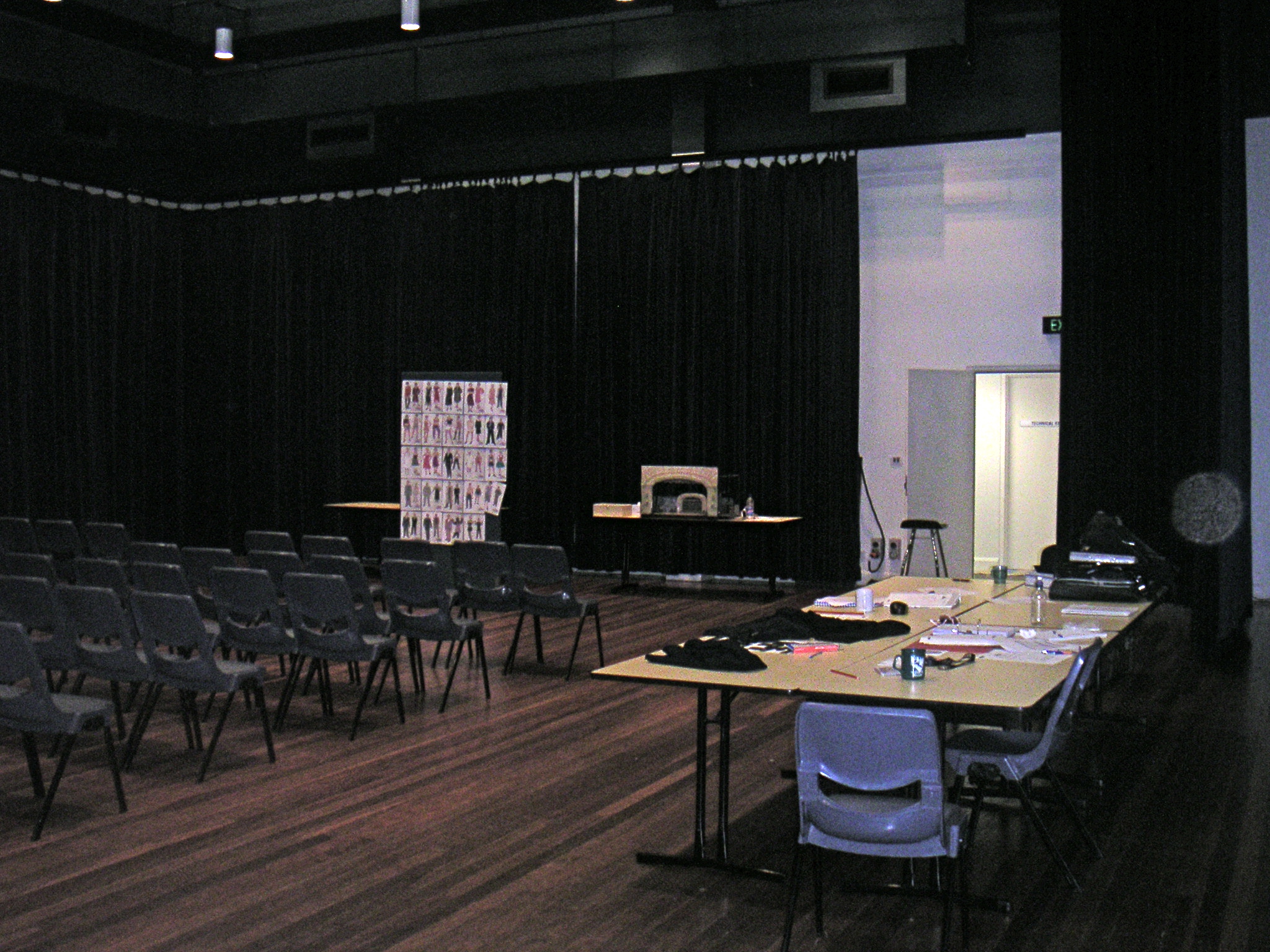
So, there we all were in the Empire Studio backstage … bright-eyed and bushy tailed. Ready to go. Got our first look at the set and costumes from Designer Greg Clarke, and a brief introduction from Director Lewis Jones on his directorial ‘vision’ … collaborative, creative, and supportive. In quick order we were measured for our costumes, ordered our production t-shirts to start spreading the news, but perhaps most importantly as rehearsals roll around from next weekend, we got a discount card for food and coffee from a local coffee shop close to the theatre. Noice.
Finished the day with a little German repast, beer and pretzels, wurst on rye, introductions and chat with theatre staff and the rest of the company. Lots of handshakes, swapping of names which will become so familiar very soon, and the promise of a rehearsal schedule in the email box early in the week from Stage Manager Jeanette Wedmaier. Yes, here I go again. It’s always a buzz.
A colleague urged me to see this trailer for the new Batman movie The Dark Knight. It must have been shot and released before Heath Ledger’s death last week, and it’s hard to watch it without thinking of the tragic loss. What emerges here is however, an eerie focus on his character, the Joker, who is seen only in heavy makeup, a mask that totally obliterates the good looks and persona of the actor behind the mask.The very brief snatches of his performance in the trailer are astonishing, powerful and riveting. There is no connection at all with other screen performances we have seen from Ledger. It is an utter transformation, vocal and physical.Was Ledger tapping into the power of the mask as a tool for character transformation? We’ll never know, and will certainly need to see the movie in its entirety before any kind of judgement on his performance can be made.
Watching this trailer got me thinking again about mask, not just in its usual representation of altering facial character, but about what I’ve come to call body-masking. Body-masking goes beyond the use of paint or any other substance that obliterates the face. It calls upon the actor to engender a sense at the outset of another’s physical form and shape, of his energy and persona triggered by observation and imagination. Body-masking creates a way for the actor to move into another recreation of a self, a possibility bounded only by the limitless power of the imagination.
One of the key terms in actor training jargon right now is transformation. It’s process and realisation. Few across most cultures would doubt the ancient power of mask in ritual and performance, itself a kind of ritual. Contemporary theatre in the main eschews mask, but the principle remains: by taking on the mask of another, the actor absorbs/is stimulated by (choose the term that suits you) its essence, and the resulting performance is enriched. What replaces the mask is a sense of the actor’s persona transcending the daily self … what is known by some scholar-practitioners as an extra-daily persona, enlivened by a heightened energy and sense of purpose.
Now I don’t know how this happens, but I have seen it happen. When an actor steps in to a sense of the other, their shape, their tempo-rhythms, and sound-making alters to a greater or lesser degree. Finding the way to get at this sense of other is the challenge. It can come through close observation of people; Alec Guinness was a great observer of the other, especially of walks. If Guinness got the walk, he knew the character would flow on through. That’s body-masking … working from the outside-in, and it’s a way I encourage my student actors to begin the process of body-masking … through observation and mimicry. Other actors just know somehow another persona and their own shape, tempo-rhythms etc. alter as a consequence. Is this what some call working from the inside-out? It doesn’t really matter. I think ultimately there’s a melding from both approaches in the crafting/artistry of building a character.
Body-masking for me is about taking on the mask wherever its inspiration comes from and letting it have its way.
Mostly I hate awards shows on television apart from the frocks and curiosity as to who will get the loot and who gives the best speech. I think you probably have to be there to appreciate the thrills involved at these dos. It was nice though to see the SAG awards ceremony today on cable tv. Everyone was all dressed up as they usually are, the frocks were lovely, the blokes brushed up well, the intro speeches were scripted to sound as flat and predictable as ever, but the individual thanks were heartfelt. What was great to see was the fact that there was a ceremony at all. It was about union solidarity. The workers united … writers and technicians said thanks to the actors for their support during the ongoing strikes, and the show (as it must) went on. Nice.
You might have caught the whole smart series of Speechless ads, actors in support of the writers’ strike. All 33 episodes are here on YouTube. This one is my favourite. Shows what good actors can do with any script.