Brisbane: Wanted – a cultural reality check

This topic continues to resonate in any gathering of arts workers in the city. We are reposting these comments from Kate Foy’s blog Groundling from 20 March for Greenroom readers.

Anyone working in the arts industry in Brisbane this week would have been aware of an article published in the Courier Mail newspaper titled ‘Brizvegas or cultural desert?’  The online version pursued the notion that the state’s capital was an arts wasteland, and it had attracted over 100 comments last time I looked.  It’s testament, I suppose, to the heat which the post engendered, and to the opportunity provided the axe-grinders by such a madly provocative, divisive premise – one based on a false dichotomy: Brisbane’s either fab or foul – and there’s nothing in between.  The article also prodded awake the cultural cringe beast, something we keep telling ourselves is dead, but which is really just dozing.

I’m convinced that we’re still suffering from the wretched cultural cringe, and I’ve been mulling over its many manifestations to try to put the article and commentary into some sort of context for myself.  AA Phillips invented the term cultural cringe in the early 1950s to explain Australia’s anxiety about its cultural status and of its perception by the wider world; 60 years on, and Brisbane appears to suffer from a localised version of the malaise. Continue reading “Brisbane: Wanted – a cultural reality check”

The best job in the world … Lewis Jones (Interview 6)

Everything’s coming up roses for the Empire Theatre right now.  Lewis Jones and I are having lunch at Encores, the very smart little restaurant attached to Toowoomba’s iconic theatre.  As is fitting for the Garden City on the Range, we can see gardenias and overflowing beds of gorgeous pink and white roses just outside the floor-to-ceiling open windows.  There’s a crisp autumn breeze, a touch of rain, but there’s no dampening of enthusiasm when Lewis talks about EPC, the Empire Theatre Projects Company – he’s its Artistic Director.  The Empire goes well with the roses; it’s a beautifully restored art deco building that is justifiably the pride of the city.  Lewis is clearly relishing his job at the helm of EPC.  Since his appointment in 2008, his task has been to establish a company to work with and reflect the community of Queensland’s Darling Downs region.

‘Friends in Brisbane ask me, How are things up there? and they think I’m joking when I say, I have the best job in the world.  I really do.’  I’m keen to hear why he thinks working in a regional city trumps a similar job in a metropolitan centre.  It seems to be all about opportunity, and it’s all positive.

Continue reading “The best job in the world … Lewis Jones (Interview 6)”

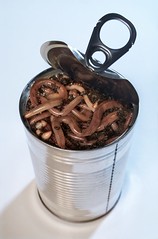
Local writing not up to scratch: us and them – again.

canofwroms
Image by Marco Veringa via Flickr

The whole issue of parochialism and the cringe just won’t.go.away!

This last week there’s been chatter on the social networks from local playwrights who are angered that a theatre reviewer considers their work to be pretty much second-rate.  There’s no doubt, if you read between the lines of some of the commentary, that writers are frustrated by the lack of opportunities – material and financial resources in particular – for new and subsequent productions of their work here in Queensland.  As many note, it is through getting your work on stage in production that you learn the craft of playwrighting.

The problems surrounding getting a new work to production, and then to a second production cannot be overstated, and it’s apparently the same in the US.  The recently-published Outrageous Fortune contends that US dramatists cannot get new works produced, and that established writers are squeezing out the newcomers.  They’re as mad as hell about it, and a series of ‘town-hall meetings’ in the American tradition were held in major US cities recently to discuss the economics and the politics of the issue.

Closer to home, the interview that sparked the reaction aired last week on 612 ABC Brisbane during a show called Drivetime.  It was one of those cosy radio roundups of the local theatre week: mild in tone, lots of laughs, anecdotes, civil airwave chat.  Local writer and theatre reviewer Sue Gough and regular theatre commenter Doug Kennedy were interviewed by Kelly Higgins-Devine.  The conversation on the week’s Matilda Awards developed around what Kennedy called the ‘positive discrimination’ at work in funding for local writers.  Sue Gough had noted the success of the unfunded 23rd Productions with The Pillowman by Irish writer Martin McDonagh.  Higgins-Devine then asked Gough point blank, ‘Are Australian playwrights up to scratch compared with some of their international peers?’  Gough (bravely and/or foolishly – depending on your point of view) responded as bluntly, ‘In a word, no,’  and went on to respond that, in Australia, you could count the ‘brilliant ones’ on the fingers of one hand.  Well, yes, I guess so.  After all, ‘brilliant’ is a big call in any country – and ‘some’ is a key word when you’re doing any kind of comparison – which we know are odious at the best of times!  If you’re interested, here’s the link to the interview.

After suggesting that local writers need the benchmarking of the best of overseas writers to ‘learn’ from, Sue Gough then went on to say that one reason the local Matilda Awards were created was to focus on Queensland work because no one from ‘the perceived centres that matter’ gets to see our work – whose perception?  As a result, Queensland productions were therefore not eligible for those other cities’ Green Room or Helpmann awards.  It was at this point when the issue of bringing ‘them’ (the critics) up from ‘down there’ to see ‘our’ work and get it ‘on the radar’, that I realised a potentially excellent discussion had been derailed – again – by the cringe beast.

So, a correction to start.  The comment that ‘our plays’ are not being seen outside Queensland is nonsense.  The Playing Australia funding scheme Sue Gough mentioned in passing (the Long Paddock process), as well as independently developed co-productions between Australian theatre companies, mean that Queensland plays, artists, creatives and their work are seen in other state regional and metropolitan centres and capital cities.  As I write, Queensland resident Michael Gow‘s Toy Symphony is on the road nationally, and, if it hasn’t already, is about to play its 100th performance.  The Matilda award-winning production (2007) of Matrix Theatre’s The Kursk by Sasha Janowicz toured nationally last year, and Queensland Theatre Company’s co-production with MTC of Let the Sunshine by David Williamson – another Queensland resident – will soon tour to Melbourne.   Then there’s Brisbane‘s The Escapists with Boy Girl Wall which played the Adelaide Fringe Festival recently, and is due to open in its home city in August this year.  This is a sampling of Australia’s national theatre – it’s common-wealth of theatres.  Is the point made?

We need more, not less public conversation about the state of the arts here and elsewhere in Australia.  There’s nothing wrong with strong points of view – in fact, we should be encouraging them – but uninformed opinion must always be challenged.  Not to do so is … unhelpful, to say the least.  So ABC, how about a series of conversations on theatre issues that matter?   I’m thinking of the kind of intelligent and entertaining jousts over film and the local industry that David Stratton and Margaret Pomeranz have from time to time.  You could do worse than by interrogating Sue Gough’s contention that local theatre needs the best of non-Australian plays to serve as a ‘benchmark’ and from which local writers can learn.  Then invite a Queensland playwright to the table.  Now that I would tune in for!

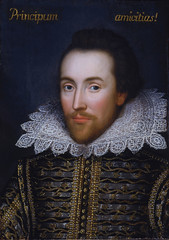
Happy Birthday Dear William! Shakespeare here, there, and on your iPhone

The Cobbe Portrait of William Shakespeare
Image by Real Distan via Flickr

It’s the Bard’s birthday today, and if you Google the name ‘William Shakespeare’ you will undoubtedly find that there are heaps of celebratory happenings around the world to commemorate its favourite, and most popular playwright.

We like this image of the Cobbe Portrait of Shakespeare which the grand-daddy of Shakespeare scholars, Stanley Wells, reckons is the real thing.  It only surfaced last year and we think it is a much nicer image of a young and sexy Shakespeare than that Chandos engraving we’re so familiar with – bald and like an ageing uncle – the one in the cartoon above.  You might also note that he is a Mac user too!

In Queensland so far this year we’ve seen professional productions of La Boite’s Hamlet, and JUTE’s Macbeth, with Bell Shakespeare‘s King Lear about to hit town for Queensland Theatre Company at QPAC.  Then Zen Zen Zo took out the Best Independent Production with their The Tempest at this year’s Matilda Awards.  Just for interest’s sake, Shakespeare remains the most produced playwright for the state theatre company.  On first glance Shakespeare and David Williamson may appear unlikely bedfellows, but they remain top of the pops for Queensland Theatre Company during its 40 year history.

Queensland has several indie companies dedicated to presenting either the original texts or variations on their themes.  There’s Shake and Stir who get around the state on schools’ tours (and nationally next year with Playing Australia funding), QSE, a training and production company based in Brisbane, and Soapbox a new company on the Gold Coast who are more than happy to bring their own brand of Shakespeare to any kind of venue, whether it’s a golf course or a night club.

Footnote:  Since Shakespeare’s last birthday, the 300 or so year quest to find the ‘lost plays’ continued apace.  There was great fanfare (well, in Shakespeare circles at least) with the authentication earlier this year by scholars at Arden Publishing, that a heavily-edited play from the 18C called Double Falsehood had, in fact, been written by Shakespeare in collaboration with John Fletcher.  What really got the Shakespeare scholars’ hearts beating faster was the fact that Double Falsehood was a rework of Cardenio, a play by Shakespeare first performed in 1612, only to disappear without a trace.  Now Cardenio, aka Double Falsehood, has been added to the Shakespeare canon; it’s been published – even on the iPhone – and the RSC are planning a production.  Wonder when we’ll get one here?

There’s a screen shot (below) of the scene breakdown of Double Falsehood which was published almost immediately it became available on the very useful iPhone app called Shakespeare Pro ($US2.99)  This is a great app with so many different features.  The one I like is the random quote; shake the iPhone when you’re in the app and you get … a random Shakespeare quote!

But back to Double Falsehood/Cardenio –  already the plot sounds awfully familiar – couple of sparring brothers (one good, one creepy – but who turns out well in the end), cross-dressing, and a double love plot.  I guess what worked the first, second, and all the other times was worth a re-work!  Shakespeare, like most good playwrights still, knew what his audience liked.

2010 Matilda Awards: all the winners

MATILDA AWARDS

Sven Swenson for his contribution as a writer, director and an actor

Michael Gow for his 11 years of programming at Queensland Theatre Company

Michelle Miall for direction

Richard Jordan for 25 Down

!Metro Arts for its independents’ season

BEST NEW AUSTRALIAN PLAY
25 Down by Richard Jordan – Queensland Theatre Company

BEST INDEPENDENT PRODUCTION
The Tempest – In The Raw Studio Season Production presented by Zen Zen Zo

BEST MAINSTAGE PRODUCTION
The Crucible – Queensland Theatre Company

BEST DIRECTOR
Michelle Miall – The Pillowman

BEST ACTOR IN A MAIN ROLE
Steven Rooke as Katurian in The Pillowman

BEST ACTRESS IN A MAIN ROLE
Stace Callaghan as William in The White Earth

BEST ACTOR IN A SUPPORTING ROLE
Chris Vernon as Michal in The Pillowman

BEST ACTRESS IN A SUPPORTING ROLE
Andrea Moor as Elizabeth Proctor in The Crucible

BEST DESIGNER
Jaxzyn (Jen Jackson) – video design – The Pineapple Queen

BEST EMERGING ARTIST
Michelle Miall  The Pillowman