Studying a Text: ideas, lines, sounds

Birkenstocks

Out of the archives. This one floated into posts read by someone today. Over three years on and I’m doing another show, but this one in my ‘own’ Australian dialect of English. ‘Colleen’ has her own, distinctive way of speaking … an ideolect … which is part of the fun of vocal characterisation for the actor.

There are probably almost as many ways of learning a script as there are actors. For me, and right now starting rehearsals for a new show it’s read, read, read the script, getting the sense of the arc of the story and my character’s role in telling it. I think it’s Anthony Hopkins who learns his lines by reading a script 100 times, and that’s it. By then, he’s immersed in the words, and works them off impulse. Well to me that’s how his relaxed natural right sounding speech seems to grow from the text.

Now the role of Cabaret’s Fraulein Schneider also requires an accent … one more thing to factor into the process of lines learning. It’s less to do with the words, and more a coming to grips with the ideas contained within or behind the words. I’m not sure where I came across the idea of words being like the flotsam and jetsam that float on the tide. They are the residue of an impulse or an energy that birthed them. Now I don’t think it’s as simple as that, and certainly I love words and the power of the crafting by the writer of those words … their sound on the ear, their butting up against one another, they playfulness with rhythm in a line … but … it’s the impulse behind the words that intrigues me initially as I chase down a character’s mindset and temperament and energy. So, it’s important for me to learn the impulse contained within words sounded in a particular way. Speech style is a function of character, and it’s not something to tack on at the last minute like a final coat of paint. Continue reading “Studying a Text: ideas, lines, sounds”
Cabaret begins: meet and greet

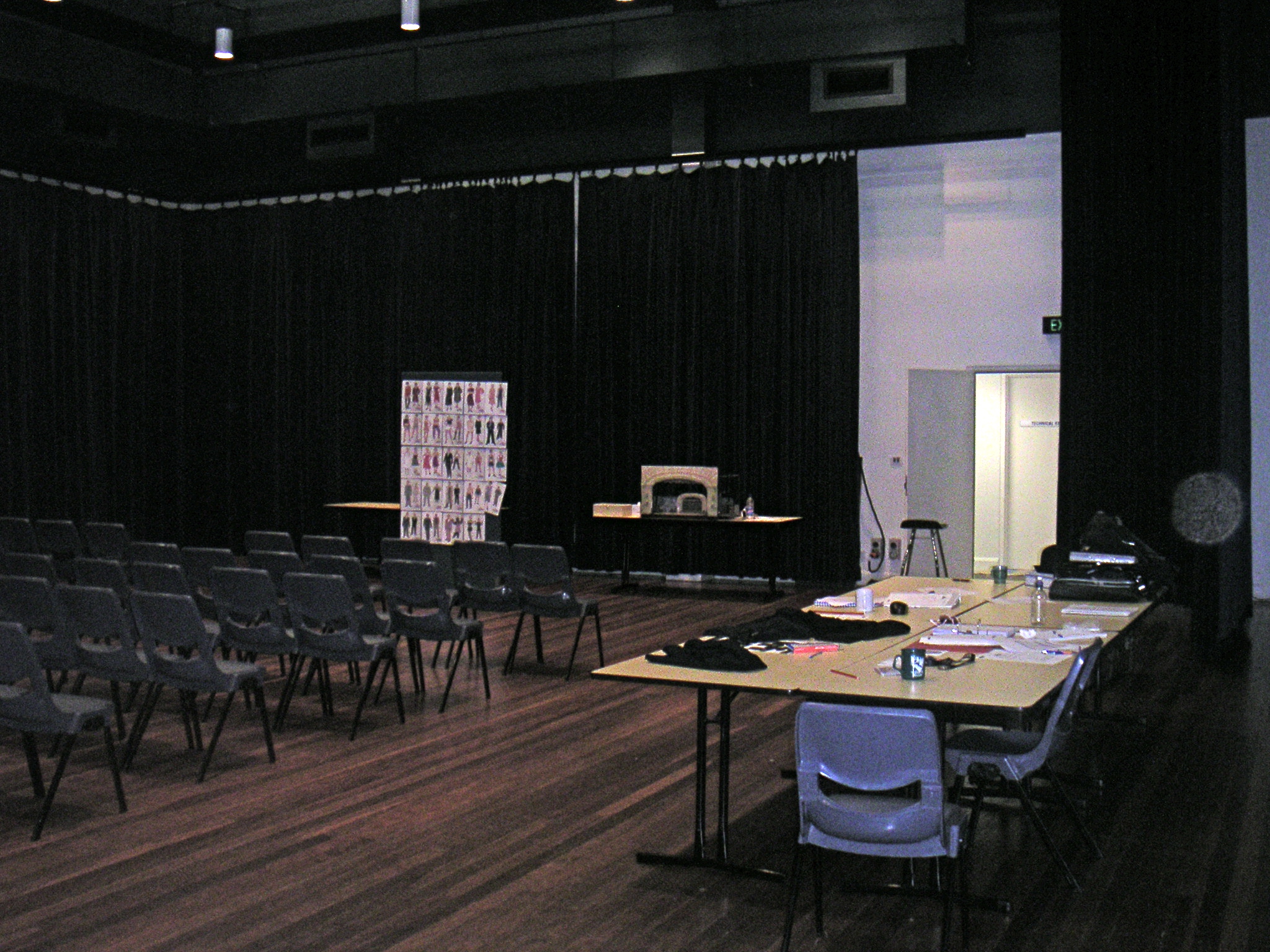
Studio in AnticipationHere we go, here we go, here we go! It’s been a couple of months since auditions and the announcement of the cast. This afternoon was the first company gathering … what’s called a ‘meet and greet.’ For most it was the first time we had got a chance to meet some of the rest of the company who will create this production of Cabaret. This first coming together with a group who will bond as tightly as a theatre company does, is inevitably exciting.

So, there we all were in the Empire Studio backstage … bright-eyed and bushy tailed. Ready to go. Got our first look at the set and costumes from Designer Greg Clarke, and a brief introduction from Director Lewis Jones on his directorial ‘vision’ … collaborative, creative, and supportive. In quick order we were measured for our costumes, ordered our production t-shirts to start spreading the news, but perhaps most importantly as rehearsals roll around from next weekend, we got a discount card for food and coffee from a local coffee shop close to the theatre. Noice.

First sight of costumes

Finished the day with a little German repast, beer and pretzels, wurst on rye, introductions and chat with theatre staff and the rest of the company. Lots of handshakes, swapping of names which will become so familiar very soon, and the promise of a rehearsal schedule in the email box early in the week from Stage Manager Jeanette Wedmaier. Yes, here I go again. It’s always a buzz.

When all is said and done …

Sir Ian McKellen takes a day out at Universal ...
Image via Wikipedia

I suppose every profession has its jargon, its arcane rituals which can look and sound absurd to outsiders, and which even initiates can find complex if not downright puzzling. When it comes to acting, many have struggled to give expression to the nature of the artform; what it is, how it happens … how to make it happen even. Mention the word ‘process’ or ‘method’ in the company of an actor or two, and stand back.

By way of an antidote to the many millions of words that have tried to tell it like it is (or should be), here is someone who knows a thing or two about the whole business. Reductio ad absurdum? Maybe. It’s certainly one in the eye for the complicators and the gurus. It’s Ian McKellen and Ricky Gervais from Extras, of course.

Reblog this post [with Zemanta]

Gone but not forgotten: my best of 2007 theatre

Wharf Sydney Theatre Company
Image by Dramagirl via Flickr

AMPAG Calendar Cover Hamlet.

Theatre’s been my life and passion for as long as I can recall. Even as a child I remember getting the **tingles** in my fingers as the house lights went to half, and the overture swelled or the curtains parted. The curtains may have gone from most theatres, but not much else has changed … you can add sweaty palms, and sometimes churning stomach to the list above when I became a professional.

I’ve had quite a few tingles this past year as audience and professional … tingle junkie me. Time to jot them down. Continue reading “Gone but not forgotten: my best of 2007 theatre”

Acting Mojo: prepping the script

If you’re a working actor you might relate to this mundane but thrilling little task. I found myself marking up my Cabaret script this morning, and it fair got me all excited it did! Now why is this so? Well, it’s taking the first step down the process road, making the first real commitment to bonding with character and getting familiar with the text, right? The job has begun even though rehearsals are weeks off.

There are some important decisions to be made here: what colour to highlight your text for a start. Now don’t laugh … this is all part of the strange, often esoteric and ritual-ridden process of working on a role. Don’t believe me? Read any of Konstantin Stanislavski‘s ABC of acting books: An Actor Prepares, Building a Character, and Creating a Role and you’ll get an idea of what strange lengths some actors have gone to in working on role.

I mark my character’s lines with one colour, and the stage directions (for now) with another. According to Robert Barton in Acting: Onstage and Off (a terrific book on contemporary acting by the way), Sigourney Weaver’s Alien script was marked up in a rainbow of colours, all of which presumably meant a great deal to her. And I know for a fact that Denzel Washington marks up and annotates his because I’ve seen a page from the Training Day script in the museum at Warner Brothers in LA. Marking up a script is more than simply highlighting your lines …

But wait, I hear you say, surely you don’t start with the markup? There are aesthetics and utility to consider before you get to the right highlighter colour. Don’t you prepare the script by firstly selecting the right binder (leather, plastic, loose-leaf; right size, weight, feel) and then cut and paste the script perhaps copying the pages up to readable size. The right glue to stick in the pages is another consideration (the adherance factor, smell). Oh and putting the obligatory begging note ‘If found please return to etc.’ notice inside the front cover? Well yes of course, all of the above. It’s all part of the process, the ritual, the mojo. Your script is going to be your closest friend for most of the rehearsal period. It’s going to be scored and annotated, erased and written over and over, forming a palimpsest of the work on role. It will most probably have a life after the show has closed, sitting on your bookshelf as a precious artefact. You need to treat it with care and respect. After all, this could be the start of a beautiful friendship, as Louis once noted to Rick.*

*Casablanca. You knew this.