Creativity, imagination … musings

I was asked by some students recently how, or whether I exercised my own imagination. We had been talking about the ‘most important muscle’, and about keeping it limber. This conversation must have stuck with at least one of the class members, who emailed me a week back wanting to know how to keep working at his acting skills over the long summer break. I wrote back urging him to keep reading, going to movies, talking … real conversation. Then I came across this series of podcasts from NYC public radio. It’s called Radio Lab on WNYC. I listened to one while commuting.

The particular ‘big idea’ that the podcast centered around was on what kind of capsules would you send into space for aliens to gather up, decode and learn something about the human condition. A writer, musician, stand-up comic, and chef put their imaginations to work and came up with wonderful sensory triggers: food, laughter, music, words … assuming aliens can use our technology and read English! Yes it was US-and Euro-centric to a certain extent, but it resonated with me. The whole series is a brain-feeder and imagination sparker.

So I’m going to add another to the ‘to do’ imagination-exercise list: share meals with friends, and savour the experience. Oh, and subscribe to Radio Lab.

Overused acting notes #2: Centre Yourself!

In this jargon-ridden acting business, the notion of ‘centre-ing’ is one that gets a daily work over in most classes and on the rehearsal room floor. I wonder what most actors make of this instruction by well-meaning directors, teachers, coaches? I’ve found it means different things to different people, so it’s worth checking through the list to ensure I’m on the same page as my actors when they or I use the term. This is how I understand it.

Centre yourself … get balanced, on alignment … probably the most basic of all. As a voice teacher I harp on the alignment, balance thing. It’s also the easiest to check and adjust. And speaking of voice, ‘breathe from your centre’ is another direction, again not too hard to check and correct. It’s about ensuring full rib-swing, and intercostal diaphragmatic breathing … in this use of the term, the centre is the solar-plexus.

‘Find your character’s centre.’ Now we are getting into esoteric territory. First up, ‘centre’ here means something like ‘where your character finds his or her energy’ and ‘where his or her centre of gravity is’ … the latter referring to work on alignment and general body-masking. The former reference ‘where your character finds his or her energy’ is the use of the term that eludes many. It is probably the least accessible or understood in practical terms, but does have some currency in talking about character; it’s a metaphor, not unlike the ancient theory of humours, in which people’s temperament was supposed to be determined by a part of their physical makeup. In that sense, it is somewhat useful but it’s not the be-all. It doesn’t necessarily translate in practical, physical terms; as with most metaphors, it works to inspire the imagination.

And then, there is the notion of the actor’s centre, another metaphor. Here, the term relates to finding the inner calm to perform in public (Stanislavski’s ‘public solitude’) whilst under stress in performance. ‘Finding’ this centre is not a grail quest, but part of the process of acting, and related to relaxation.

Centre yourself is not a bad instruction or self-check, but be clear about what it is you’re doing.

Overused acting notes #1: Being in the Moment

If there’s one phrase that an actor can get tired of, it’s that old favourite ‘being in the moment.’ I count myself as one who finds it tedious. It doesn’t mean I shouldn’t pay attention to it, or that it isn’t relevant … a lot of the notes I’ve given and received have been about this lack of ‘being in …. .’ But as an acting principle, it can be misunderstood. Bear with me.

There are a couple of states of being at any moment when acting … you the actor, and you the actor as if character. To deny these states of being is a misunderstanding of the basics of acting as well as the human capacity to engage imaginatively (or otherwise) with more than one thing at a time. I’ve had students who got the whole idea of characterisation mixed up with who they were supposed to ‘be’ at any given time on stage. You can’t be ‘you’ and the ‘character’ at one and the same time? Well, hello … who is it up there? We’re talking art here people.

Being in the moment for me means being fully present as actor and actor as character; I am available as needed moment by moment, beat by beat as I engage with stage action. I retain aesthetic awareness … control over the performance, and remain open to the small and large variations in the playing ‘as if’ I were Hamlet’s mother, for example. But it’s a balancing act.

If I slip too far one way or another, I am likely to find my actor’s sensibility jumping to the next page and disengaging from the character’s understanding of what’s going on. ‘Don’t play what’s on the next page’ is a note I find myself giving, and a check I need to keep giving myself as I perform. If I’m too immersed in actor as character, I run the risk of self-indulging and losing touch with the audience and the tempo-rhythms of the scene. Balancing act indeed, and part of the art of acting, being fully ‘in the moment’ as the artist. No wonder Stanislavski paid so much attention to relaxation and concentration.

‘Being in the moment’ is one of those principles of good timing and good acting hygiene that we need to keep learning again and again. Perhaps that’s why I find it tedious!

Image: Artistry

Reblog this post [with Zemanta]

Working on a Poem

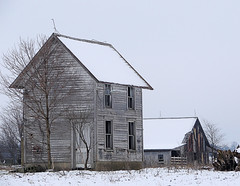
Winter Wellhouse (and Barn)
Image by cindy47452 via Flickr


An old friend in the clergy called last week and asked me if I would like to read a poem at the Carols and Lessons ceremony on Advent Sunday evening.
I am always honoured when these requests come to me, and of course flattered that I have been asked.

The wonderful Cicely Berry in her seminal book Voice and the Actor recommends poetry as quite the best material for an actor to work on. She’s on the money. I use it with my students all the time. Why? Because there is the chance to engage with language in a visceral way … emotions are closer to the surface in poetry … and it asks you as the actor to find the ‘size’ in yourself to match the heightened nature of the text. There’s often rhythm and rhyme to play with too, but not always. And of course, finding and revealing character in a very short space of time is a great challenge.

The piece I’m working on is The Innkeeper’s Wife by Clive Sansom, a lovely first-person, chatty monologue about the byre where the Christ child had been born, as she tells it, long ago. She’s talking to a carpenter who’s come to tear down the dilapidated stable and burn the wood. She reminisces about that night and doesn’t understand why she recalls it so vividly. Ah, but we do, of course. Shaking her head, she heads back inside to the inn to serve the customers more wine.

Finding her ‘voice’ to match the tone of the poem is the challenge with this one. Can’t be sentimental; she’s a no-nonsense woman. Her husband died years ago; she’s managed the inn since. There’s the trap in pieces like this, especially with religious text, to sentimentalise the whole thing and spoil the decidedly matter of factness of it all, or of making it too ‘actory.’

I try to find a role model in mind to work on as I prep for any role. Our city’s mayor, a no-nonsense, call-a-spade-a-shovel-if-you-have-to woman springs to mind. Hers is the body mask I will use to bring the Innkeeper’s Wife to life tomorrow evening. Meanwhile, I read and re-read till the cold-read becomes warmer and the text so familiar that I can relax into it.

The poem appears in A Pocket Book of Spiritual Poems collected by Rumer Godden, Hodder and Stoughton 1996.

It’s All In the Timing

One of the talents I envy most in an actor is the gift of good timing. Of course you don’t have to be an actor to take advantage of this skill if you have it. It helps in life as well as in art.

I saw good timing in action yesterday morning at a breakfast launch of ‘Life Is …’ the Empire Theatre’s Season 2008. Chairman Peter Swannell has the gift of the gab as a speaker, and as MC, managed some deft one liners and killer punch lines. Ruth Hodgman, the Empire’s Manager of Programming, Promotions & Development had the job of coordinating the slideshow presentation, and did so with a beguiling ease. It’s not a simple job to stay focussed and keep the audience’s attention, while interacting with media, and all this at 7am. Nice work.

And it was time to announce the theatre’s own production for next year. There was a good buzz in the room of mainly business sponsors, staff, board members and friends as season 2008 was rolled out. As far as Cabaret is concerned, it’s now time for the theatre management to start the marketing and promotional activities, and for the creative and artistic team to block out the calendar for the rehearsal period and start the prepping.

Time for regular singing lessons for me in the New Year, and for hitting the fitness trail again. For me it’s always been running that’s got me fitter faster. I remember a nearly 6 month prep period way back when I was readying to play Nora in A Doll’s House for Queensland Theatre Company. I knew I’d be on stage for most of the 2 and a half hours playing time, wearing 19th century heavy costume, corseted and bustled, and in summer.

I’m not sure whether it’s going to be running for me just yet. Let’s go with walking and the stationary bike first and see where that gets me. Increased stamina, breath support, flexibility and just feeling as though I’m physically ready is what I’m aiming for. It’s the support system I need as an actor; if I’m feeling good physically, I’m ready for the creative and imaginative challenges … without it, I’m running to catch up.